Most of us know a kid — or were a kid — who could read at a college level in second grade but somehow couldn’t remember a permission slip, finish homework, or keep life together. Brilliant on paper. Struggling underneath.
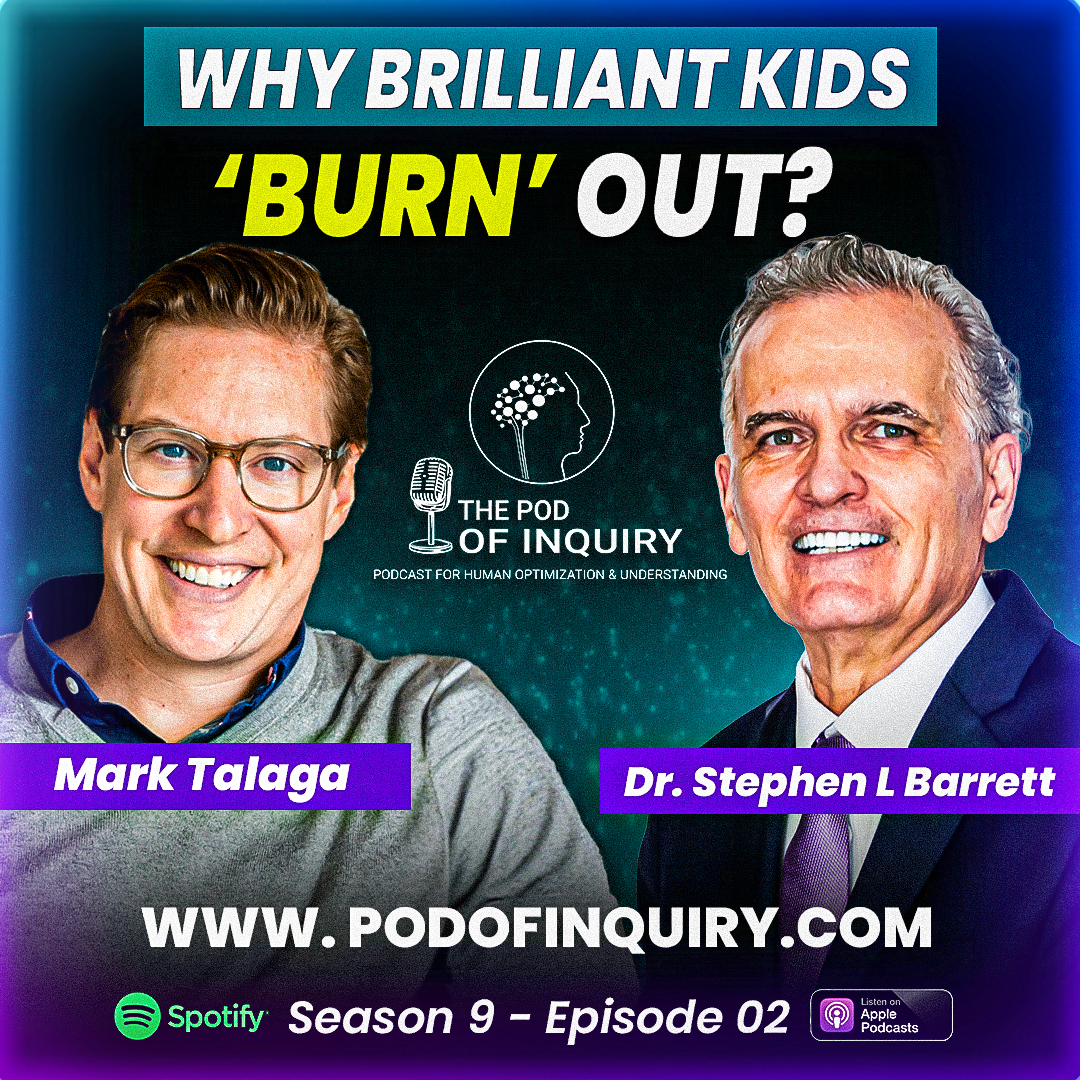
This week on Pod of Inquiry, I sit down with Mark Talaga, LPC — host of the Hopelessly Gifted podcast and director of the Center for Identity Potential — for one of the most eye-opening conversations we’ve had about giftedness, executive function, ADHD, anxiety, and the misunderstood world of “twice exceptional” kids.
We explore why giftedness is far more than a high IQ score, how asynchronous development creates hidden struggles, and why so many brilliant children end up overwhelmed, mislabeled, or emotionally exhausted. (Why Brilliant Kids Burn Out)
In This Episode:
- Why “gifted” is a developmental profile — not just intelligence
- The hidden gaps behind high-performing kids
- Executive dysfunction, masking, ADHD & anxiety in gifted children
- Why “twice exceptional” often means far more than 2e
- The real meaning of asynchronous development
- Boys vs. girls: how gifted struggles show up differently
- Video games, false mastery & emotional escape
- Why neuropsych testing can change everything
- Mark’s personal journey from gifted kid to therapist
If you’re a parent, teacher, clinician — or someone who grew up feeling “smart but struggling” — this conversation may explain more than you expect.
🎧 Watch now and share with someone who needs this conversation.
Watch The Podcast
Listen to The Podcast
Also available on


Author Biography

Mark Talaga
Mark Talaga is a counselor, speaker, and consultant specializing in the social, emotional, and developmental needs of gifted and twice-exceptional individuals. Through his work with the Center for Identity Potential, he helps educators, clinicians, and families better understand how cognitive intensity, executive functioning, and processing differences shape learning and identity. His trainings translate complex neurodevelopmental concepts into practical strategies that strengthen relationships and support more effective engagement for advanced learners across educational and counseling settings.
Show Notes from this episode
Introduction & Defining Giftedness
- [00:00] Cold open and intro. Dr. Barrett introduces Mark Talaga, his Hopelessly Gifted podcast, and the Center for Identity Potential.
- [01:18] Show open. Why “hopelessly gifted” is paradoxical — and why Mark dislikes the word “gifted.”
- [02:34] What giftedness really means: development extreme on the bell curve in any domain — intellectual, artistic, athletic, even moral. It is not a test score.
- [04:00] Different flavors of giftedness and why being “smart” doesn’t guarantee an easy life.
- [05:57] Defining neurodivergence — and why it likely covers more people than the public realizes.
Asynchronous Development & the “Twice Exceptional” Myth
- [06:31] Are all gifted kids impaired? The role of family, environment, and supports in determining outcomes.
- [08:07] When giftedness creates the problem: Jen Merrill’s book If This Is a Gift, Can I Return It?
- [08:32] Misdiagnosis: when ADHD/ADD labels flatten what is really going on.
- [09:25] “Twice exceptional” (2e) explained — and why Mark argues it’s really 10e: sensory, auditory, language, processing, and more.
- [10:03] Barrett’s real-world story — the bored sophomore who dropped out, then earned a PhD in English and became a dean.
- [13:23] How false labels can crush a lesser child, and why compliance is not the same as education.
Evaluation, Assessment & Hard Data
- [14:09] Why misdiagnosis is rampant — and why brilliant kids are exceptionally good at masking weakness.
- [15:44] How the practice evaluates: comprehensive neuropsych referrals with 50+ subtest scores to make the case to rigid institutions.
- [17:26] Team-based assessment: why these cases are too complex for one clinician working solo.
- [18:54] Anxiety and depression as symptoms of the gaps — root cause matters.
- [19:48] The classic profile: a 99.9 percentile Verbal Comprehension Index paired with single-digit percentile Processing Speed and Working Memory.
Building Skills, Executive Function & the Coaching Mindset
- [20:14] Building processing speed: diet, awareness, self-advocacy, and tried-and-true skills like learning to take notes.
- [21:21] The athlete analogy — the gifted child as the talented but uncoachable player who needs to get dialed in.
- [23:01] Executive function as dynamic and context-dependent. Why prefrontal-cortex regulation lags in gifted profiles.
- [24:47] What do you actually want? The therapist as coach, not grade-enforcer.
- [25:28] Tying shoes vs. solving equations — meeting the kid where they are developmentally.
Asynchrony, Environment & the School System
- [27:32] Asynchronous development defined — and why it sits at the core of this work.
- [28:39] Environmental fit: when the classroom is wrong, what changes — assisted listening devices, pre-teaching the lesson, or a school change.
- [30:33] Passion and interest as a workaround for executive-function deficits — and the trap of only chasing what feels easy.
Age, Sponsor Break & Career Path
- [31:23] Average ages of presentation: behavioral chaos in young children, tanking grades in middle school, depression and lostness in high school, and struggling adults too.
- [33:31] ADHD as a “ticket to ride”: hyperfocus and superpower vs. disruption.
- [34:25] Mark’s windy road — from gifted kid to broken college student to video-game producer to gifted-kids therapist under mentor Andy Mahoney.
- [36:14] Why lived experience makes the ultimate clinician — a critique of the ivory-tower problem in academia and medical training.
Video Games, Social Media & Modern Pressures
- [36:56] The video-game question framed as a therapeutic-window problem — efficacy vs. toxicity.
- [37:43] Why video games are powerful teachers and create a feeling of “false mastery” — especially for gifted kids.
- [39:08] Why gifted kids gravitate to gaming more than peers, and what parents should actually look for.
- [40:14] Video games as symptom, not problem — titrating away from a coping tool while building real-world skills. Mark’s own 8-hour-a-day gaming history.
Sex Differences, Success & Connection
- [41:33] Boys vs. girls: external squeaky-wheel behavior vs. internal overcompensation and anxiety. Cultural blind spots in identification.
- [42:42] Prognosis: earlier identification yields better outcomes — and redefining what “success” means for a family.
- [45:02] Barrett on success as the capacity to be happy, to connect, and to belong to a community.
- [45:55] Why brilliant people build airtight defense mechanisms — and how to bypass them to reach the lonely person underneath.
- [47:11] Hope as a real pathway, not a platitude.
- [48:01] Where to find Mark: CenterForIdentityPotential.com and the Hopelessly Gifted podcast on Apple and Spotify.
- [48:50] Closing thanks.
Sponsors Of The Episode





BBACK US
BBACK is a balance shoe that improves movement and makes each step easier.
PRO-DYNAMIC® tech supports natural motion, reduces pressure, and aids circulation.
Use code: POI10 for 10% off your order










Approved Medical Solutions
Your source for Oxalate free Nitric Oxide Supplementation
Non-licensed patients can use code “sbarrett” for a 10% discount.
Licensed practitioners can access the discounts by registering and when at checkout put “podofinquiry” (no space and not case sensitive) in the coupon section.

Ketone
Nitric Oxide
ClearDetox Pro & ClearSleep