
🧠 What if we could analyze 41 million mental health patient records and finally uncover the hidden patterns driving depression, anxiety, schizophrenia, addiction, and more?
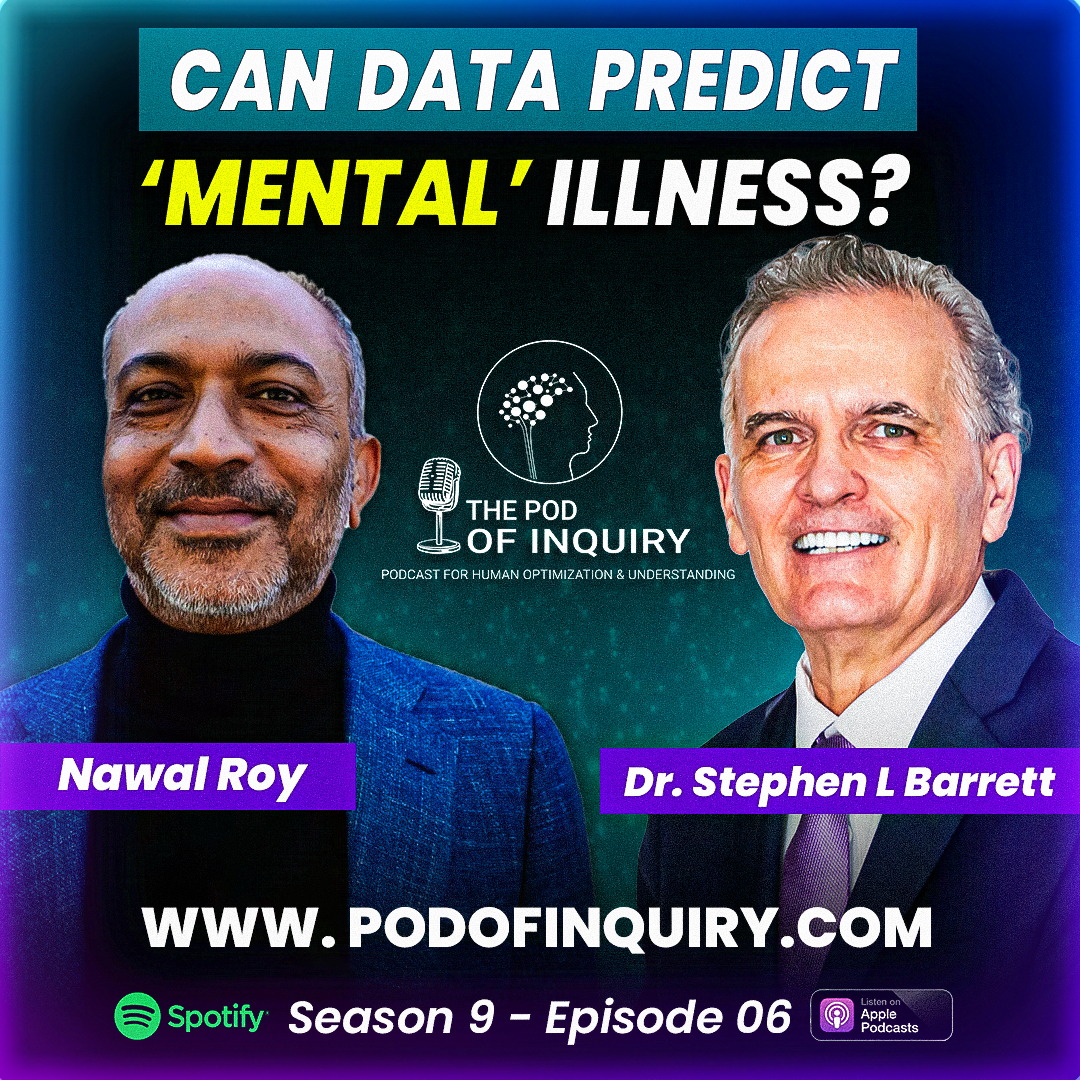
In this episode of Pod of Inquiry, we sit down with Nawal Roy, Founder & CEO of Holmusk, the world’s largest HIPAA-compliant real-world evidence company focused on mental health and neuropsychiatry.
After spending more than a decade building a platform containing 41 million patient records and over 5 trillion clinical data tokens, Nawal is helping researchers, clinicians, hospitals, and pharmaceutical companies answer questions that traditional healthcare systems have struggled to address.
We explore why mental health has been left behind in healthcare digitization, how depression and chronic diseases like diabetes are deeply connected, and why the future of psychiatry may depend on data, AI, and digital phenotyping rather than traditional symptom-based diagnosis. (Can Data Predict Mental Illness)
In This Episode you’ll discover:
- Why mental health was largely excluded from healthcare modernization efforts
- The surprising connection between depression, obesity, and diabetes
- What “digital phenotyping” means and how it could transform psychiatry
- Why depression patients often spend years searching for effective treatment
- The massive evidence gap in mental healthcare research
- How social media is reshaping mental health outcomes
- Nawal’s warning about the rise of “virtual psychosis”
- The promise and risks of artificial intelligence in healthcare
- How Holmusk’s NeuroBlue platform is changing mental health research
This conversation offers a fascinating look at how big data, AI, and real-world clinical evidence could reshape the future of mental healthcare.
🎙️ Subscribe for more conversations with leading experts in health, longevity, medicine, neuroscience, and human performance.
.
Watch The Podcast
Listen to The Podcast
Also available on


Author Biography

Nawal Roy
He is the Founder and CEO of Holmusk, a global digital health company he established in 2015 to revolutionize mental and behavioral health through real-world clinical data. Inspired by his experience across Wall Street banks and McKinsey, Nawal recognized the transformational potential of real-world evidence to address the critical need for better mental health care.
Under his leadership, Holmusk has secured over $100 million in financing and launched NeuroBlu, a flagship data analytics platform powered by the world’s largest behavioral health real-world dataset. Beyond Holmusk, Nawal serves as a board member for the Healthy Brains Global Initiative, has been Co-chair of the Kennedy Forum’s Data and Measurement Committee since 2023, and was a member of the World Economic Forum’s Global Future Council for Mental Health in 2021–2022. He holds an MA in Economics from the University of Mumbai and an MS in Quantitative Analysis from the University of Cincinnati.
Show Notes from this episode
Introduction & Guest Background
[0:00] Dr. Barrett introduces Nawal Roy and frames the episode: Holmusk holds the world’s largest HIPAA-protected clinical mental health database — 41 million patients and growing — used to study comorbidities, treatment outcomes, and longitudinal mental health trajectories.
[1:10] Podcast intro — the Spelunkers welcome sequence.
[1:41] Dr. Barrett opens the conversation: defining ‘big data for mental health’ and setting the stage for what Holmusk does.
The Founding of Holmusk — An Economist’s View of a Broken System
[2:11] Nawal Roy introduces himself: founder and CEO of Holmusk, the largest clinical data company focused on neuroscience. Background in economics and finance; saw healthcare data transformation reshape financial markets and set out to do the same for neuropsychiatry.
[3:21] Company HQ in New York; Holmusk is 11 years old, founded in 2015 — well before mental health entered mainstream discourse. Roy’s thesis: neuropsychiatry is the largest untapped market and the single biggest driver of comorbid disease burden.
[3:56] Dr. Barrett references Roy’s observation that mental health may be ‘the next cancer.’ Roy frames the problem economically: 70% of all healthcare costs are driven by 5 major chronic diseases — and each is highly comorbid with mental illness. The diabetic patient also has depression; we treat one and ignore the other.
[5:05] Systematic neglect of the mind-body relationship: healthcare has been optimized for mortality, not disability. A generation of young adults is becoming functionally disabled in their mid-20s — an unprecedented and underappreciated burden.
[5:45] Dr. Barrett notes the mind-body connection was once fringe; Roy confirms the economic rationale drove him to build a foundational data infrastructure: the science is broken, the care protocols are broken, the payment models are broken. Data is the substrate on which all of those can be rebuilt.
Building the Platform — Barriers to Entry & the Curation Engine
[6:22] Roy’s framing: solving the evidence gap is the master problem. Solve evidence; stigma and access follow. His reference model: Bloomberg in finance — industrial-scale, scientific-grade data at your fingertips.
[7:40] The NeuroBlue platform explained: cloud-based, queryable database. Holmusk’s initial acquisition was a specialist mental health EHR from Duke University with 500,000 patient records built over 20 years. First mover advantage — but converting raw EHR data into a structured, queryable database was a massive data science challenge.
[9:30] The curation engine: Holmusk spent $50–70 million building proprietary infrastructure to translate unstructured raw clinical data into structured, analysis-ready fields. NeuroBlue serves as the intelligence layer; the evidence layer delivers outputs to clinicians, pharma, and academic institutions (Oxford, Stanford).
AI Integration — From Machine Learning to Frontier Models
[10:22] Dr. Barrett asks about AI. Roy distinguishes the pre-2022 era (ML, NLP, neural networks) from transformer-based frontier models (ChatGPT era, 2022+). Holmusk has always used AI — originally to convert unstructured physician notes into structured data fields — and continues integrating modern LLM tools at increasing speed.
[12:15] Key tension in healthcare AI: balancing speed, accuracy, and safety. Optimizing for one compromises the others. Roy emphasizes that all three must be managed simultaneously.
Scale — What 41 Million Patients Actually Means
[12:28] Holmusk now holds data on 41 million patients. The original goalpost was 6–8 million patients and 25–30 publications to reach ‘gold standard’ status. They’ve surpassed both: 41 million patients, 100+ peer-reviewed publications.
[14:38] In AI terms: 5 trillion tokens across the dataset — approximately 110,000 tokens (≈60,000 words) per patient on average. Roy’s framing: ‘I can write a book for each patient.’ For high-density patients (top 20%), an encyclopedia.
[15:47] SPONSOR BREAK — ValAsta Astaxanthin (code: POI5)
[16:38] The scientific value: unprecedented longitudinal understanding of what has worked, what hasn’t, and what factors drive outcomes — at a population scale previously impossible.
Pharma Applications & Digital Phenotyping
[17:01] How pharma uses the platform: identifying patient phenotypes for drug development and targeting. Digital phenotyping — characterizing a patient’s disease progression, onset, age, and trajectory — allows pharmaceutical companies to find the right patient population for a given drug or indication.
[18:38] Dr. Barrett raises lifestyle-mental health intersections (runners, weightlifters, dietary adherence and lower mental illness rates). Roy positions Holmusk as infrastructure — ‘we built the road; whether you drive a Ford or a Ferrari, that’s up to you.’ Any researcher can query the dataset.
[19:59] Practical example: a company interested in heart rate variability monitoring could query the 41-million-patient dataset for a relevant subset. The platform is available to universities, individual scientists, pharma, clinicians, and hospital systems.
The Evidence Gap — Why Mental Health Was Left Behind
[21:53] Roy identifies the biggest surprise: how thoroughly broken the mental health sector is — not from lack of will, but from lack of foundational data infrastructure. Comorbidity is more prevalent than anyone acknowledged: >50% of diabetic and obese patients have depression or a mental disorder.
[22:40] Dr. Barrett: depression may be the single most ubiquitous symptom of diabetes — and almost universally untreated. Roy’s retort: how many diabetic patients are even being asked about it, let alone treated for it?
[23:27] Structural causes of the evidence gap: (1) The HITECH Act digitized physical health records but explicitly excluded mental health; government spent ~$37B on EHR digitization and left psychiatry out. (2) Mental health parity in insurance didn’t exist until 2008 — and violations remain endemic even today.
[26:25] The evidence model that works in cardiology and oncology is completely absent in mental health. Trial-and-error is the standard of care: average depression patient waits 10 years before seeking treatment, tries ~10 medications over 18 months before finding one that works.
Digital Biomarkers & Measuring Functional Improvement
[28:31] The biomarker problem: unlike cardiology (ejection fraction, troponin) or oncology (tumor markers), mental health has no objective biomarker. Roy’s solution: build digital biomarkers — proxy measures of functional status. Can this person hold a job? Maintain relationships? Perform daily responsibilities?
[29:43] Longitudinal tracking enables both improvement and decline curves — a critical advantage over snapshot-in-time assessments. The same infrastructure that catches improvement catches early deterioration.
Stigma, the Social Ecosystem, and the Jail-Care Problem
[29:50] Stigma discussion: Roy notes AIDS in 1990 had stigma far worse than mental health today — and was effectively destigmatized within 20 years. Mental health is a three-sector problem: healthcare, social care, and incarceration. 50% of the U.S. prison population has a diagnosable mental health condition.
[31:12] SPONSOR BREAK — BBack 0524 footwear (code: POI10)
[32:04] Roy: Holmusk focuses only on the clinical component of mental health — the subset where data and evidence can move the needle. Solving the clinical layer reduces downstream social and incarceration burden.
[33:22] Dr. Barrett: optimizing mental health care will reduce incarceration. Roy: agreed — the causal chain runs directly from untreated mental illness to incarceration.
Social Media, Virtual Psychosis & the Coming Mental Health Crisis
[33:40] Social media’s role: Roy confirms the science is clear — platforms like Meta and YouTube have demonstrably increased anxiety and suicide risk, particularly in female adolescents. The data shows social media is the primary driver of anxiety disorder onset in young women.
[34:14] Roy’s prediction: within 5 years, ‘virtual psychosis’ will become a clinical phenomenon — patients who cannot distinguish between the real world and the virtual world. A generation raised entirely on screens, with 1,000 social media connections and no ability to greet someone in person.
[35:14] Dr. Barrett: already observing this on X — a majority of viral posts are fabricated; fact-checking is essential but exhausting. Roy: the generation that learned critical thinking from diverse information sources is disappearing. The next generation grew up on algorithmically curated, bot-generated content and lacks the framework to evaluate it.
[37:08] Roy shares a case: a person in New York showed up at a woman’s home after an extended online relationship, only to discover she was a chatbot — and subsequently took his own life. Roy’s test: ‘Can you touch it? If you can’t touch it, it’s not real.’
[38:14] Dr. Barrett frames AI’s dual nature: a drug with therapeutic windows, no regulatory harness, and entropy-level acceleration. Roy’s analogy: nuclear fusion — the same technology that could solve the world’s energy crisis could destroy it. ‘In very high likelihood, it is going to be both.’
How to Access the Holmusk Platform
[40:05] Platform access: Holmusk is available to any scientist, researcher, clinician, hospital system, or university. License cost: $60,000/year for full platform access. Additional options include grant collaboration support, bespoke tool development, team AI training, and system-level initiatives (e.g., ‘reduce our suicide rate by 30%’).
[41:57] Next frontiers: (1) Neurodegeneration — Alzheimer’s, dementia, and the neuropsychiatry-neurodegeneration link; (2) Comorbidity markets — diabetes + depression, GLP-1s + anxiety; (3) Training data for a ‘ChatGPT for mental health’ — a use case Roy says could democratize access to psychiatric guidance at scale.
Closing & Contact Information
[43:28] Dr. Barrett closes: the platform’s most underappreciated value may be its patient recruitment asset — the hardest problem in clinical research. Holmusk offers 41 million patients as a queryable cohort.
[44:36] Roy: ‘We have built something I am truly proud of — a massive value add to the whole system.’
[43:48] Contact: Holmusk — holmusk.com | Nawal Roy on LinkedIn or nawal.roy@holmusk.com
[44:54] SPONSOR READ — Clean Ketones by Approved Medical Solutions (Improved Medical Solutions)
[47:00] Closing remarks, sponsor callouts, Spelunkers sign-off, and legal disclaimer.
Sponsors Of The Episode






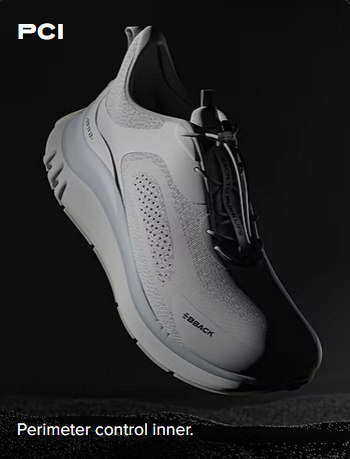
BBACK US
BBACK is a balance shoe that improves movement and makes each step easier.
PRO-DYNAMIC® tech supports natural motion, reduces pressure, and aids circulation.
Use code: POI10 for 10% off your order









Approved Medical Solutions
Your source for Oxalate free Nitric Oxide Supplementation
Non-licensed patients can use code “sbarrett” for a 10% discount.
Licensed practitioners can access the discounts by registering and when at checkout put “podofinquiry” (no space and not case sensitive) in the coupon section.

Ketone
Nitric Oxide
ClearDetox Pro & ClearSleep