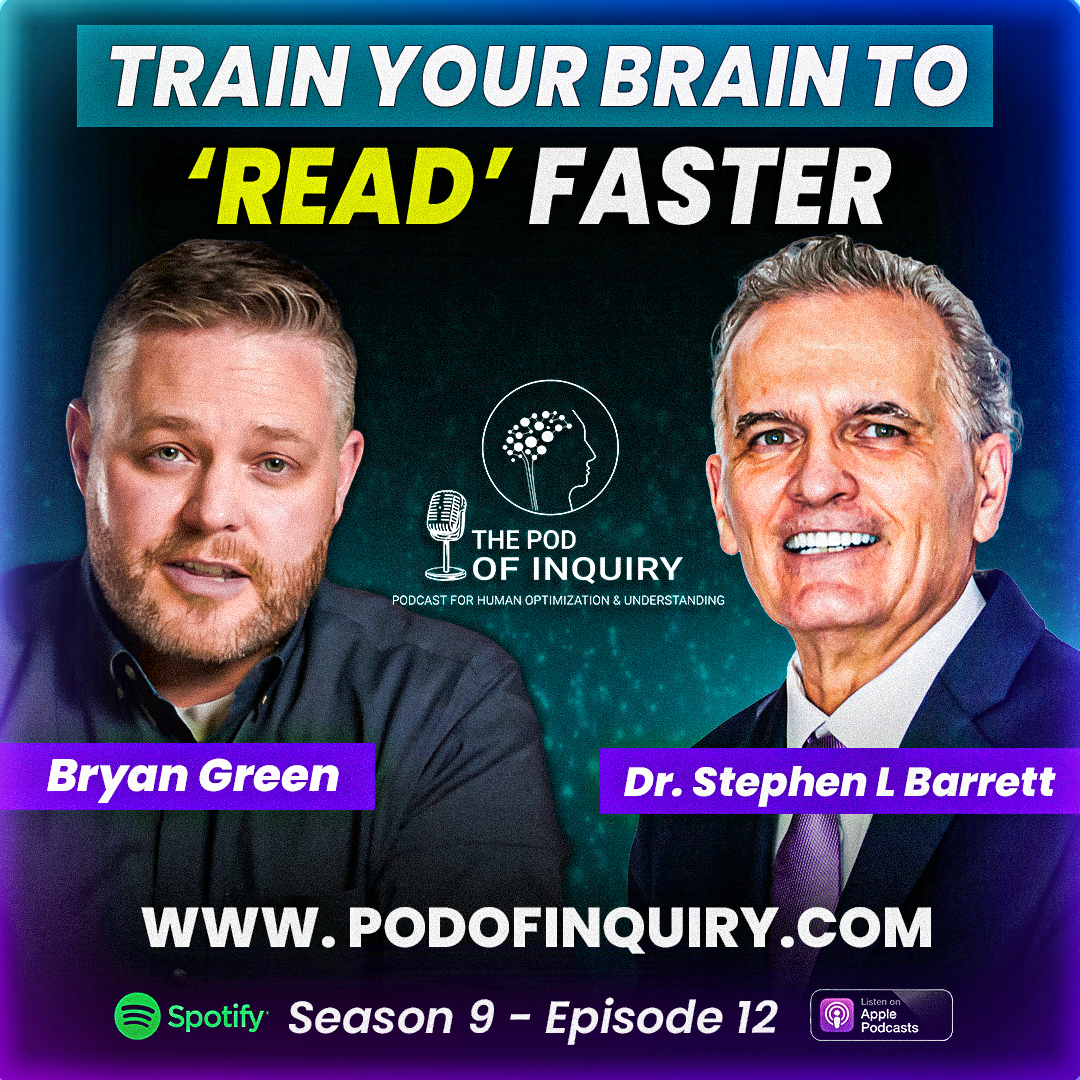
What if a 7-minute daily habit could dramatically improve your reading speed, focus, and cognitive performance?
In this episode of The Pod of Inquiry, Dr. Stephen Barrett sits down with Bryan Green, COO of Infinite Mind, to explore the neuroscience of speed reading and cognitive enhancement. Drawing on independent university fMRI research, Bryan explains how targeted cognitive training may activate significantly more areas of the brain than conventional reading, potentially transforming how we learn, retain information, and maintain long-term brain health.
Is speed reading really backed by science? Can cognitive training improve academic performance, help people with ADHD, and even play a role in reducing Alzheimer’s risk? We dive into the evidence, the controversies, and the practical techniques anyone can begin using today. (Train Your Brain to Read Faster)
In This Episode you’ll discover:
- How cognitive training changes brain activity
- Why traditional reading limits your potential
- How to overcome subvocalization
- The optimal speed for reading and comprehension
- The research behind improved academic performance
- ADHD, hyperfocus, and learning potential
- Cognitive training and Alzheimer’s prevention
- Why 7 minutes a day can make a difference
Whether you’re a student, lifelong learner, educator, entrepreneur, or simply interested in optimizing your brain, this conversation offers practical insights grounded in neuroscience and real-world outcomes.
👍 If you enjoy evidence-based discussions on health, longevity, neuroscience, and human performance, like this video, subscribe, and turn on notifications so you never miss a new episode.
Watch The Podcast
Listen to The Podcast
Also available on


Author Biography

Bryan Green, COO of Infinite Mind
Mr. Bryan Green is COO and CMO of Infinite Mind, the Salt Lake City-based creator of eyeQ, a speed-reading and cognitive performance training platform originally developed in Japan and brought to the U.S. by founder Jeffrey Flamm. Infinite Mind is the creator of eyeQ, described as America’s best-selling speed reading and learning enhancement product, and Bryan leads both operations and marketing for the company. He holds an MBA from the University of Phoenix (2006–2008) and brings prior experience from roles at Big Lure Marketing, OPSGEAR, Inc., DriverTech, and Brookside Broiler & Grill. He’s based in Bountiful, Utah, and has appeared on several podcasts discussing the neuroscience behind brain training and speed reading, including Infinite Mind’s own Brain Lab Podcast.
Show Notes from this episode
[00:00] Dr. Barrett opens the episode introducing Bryan Green, COO of Infinite Mind, and previews the episode’s core claim: independent fMRI data showing a 1,500% increase in brain activity from the platform’s training.
[01:41] Guest welcome. Dr. Barrett frames the conversation around “brain exercise” as a modality, parallel to physical exercise.
Origins: From Japan to a Speed-Reading Movement
[02:13] Infinite Mind’s training methodology originated in Japan with Dr. Akihiro Kawamura, a double-PhD educator. Founder Jeffrey Flam brought it to the U.S. after it proved transformational for his own family.
[03:13] Originally branded as a speed-reading program in the late 1990s/early 2000s — before fMRI technology and the language of “brain health” were culturally available — even though the underlying methodology hasn’t changed.
[04:00] Dr. Barrett draws the analogy to gym training: reading is a cognitive “muscle group,” and speed reading upregulates overall cognitive function much like targeted exercise builds specific muscle.
[04:48] Green connects the discussion to an aging population: the baby boomer generation is retiring in record numbers as reports of Alzheimer’s and cognitive decline rise, driven partly by lifestyle convenience and reduced cognitive load.
[07:03] A brief history of speed reading — Evelyn Wood and her influence on President Kennedy’s White House staff.
The Neuroscience of Subvocalization
[08:15] Green defines subvocalization — the internal “sounding out” of words learned in early childhood reading education — and explains why most readers never outgrow it.
[09:49] The neural-pathway-as-hiking-trail analogy: the more a mental habit is repeated, the deeper the “rut,” and the harder it becomes to break.
[11:10] Dr. Barrett raises the comprehension-versus-speed tradeoff — is faster reading actually retained?
[12:41] Green’s key data point: the average adult reads at ~200 words per minute, largely paced by internal speech. Doubling that to ~400 wpm — not 1,000+ wpm — is the genuine “sweet spot” where engagement and comprehension actually improve.
[14:19] A tangent on vowel-removal reading tricks seen on social media — Green explains why the brain can decode consonant-only text, but why Infinite Mind’s approach favors processing every word rather than skimming, to avoid losing meaning in contractions and context-dependent phrasing.
The fMRI Data: A 1,500% Increase in Brain Activity
[18:21] The “transfer effect”: converting information consumed into information utilized. Green details two independent university fMRI studies. Baseline scans showed only Broca’s and Wernicke’s areas (the language centers) activating during reading.
[20:24] After eight weeks of training (minimum three days/week), post-training scans showed brain activity increased 15-fold — 1,500% — well beyond the language centers alone, implicating memory, reasoning, and conceptual-learning regions activating simultaneously.
[21:27] A separate academic-outcomes study at a low-performing elementary school found a 22.3% increase in correct answers across language arts, math, and science after three months of training — verified by an independent statistician.
[23:06] Dr. Barrett connects this to modern neuroscience’s move away from siloed brain-region models toward a more connected “connectome” view, referencing default mode network research in depression.
A Word on the Competitive Landscape
[25:40] Dr. Barrett raises the Lumosity/FTC settlement from the mid-2010s. Green is careful to avoid speculating on specifics but distinguishes Infinite Mind’s approach — cross-domain brain activation via stacked cognitive tasks — from narrowly-targeted single-skill training.
The Program: Dosing, Guarantee & Use Case
[29:51] Minimum effective dose: 7 minutes of training, ideally 5 days/week. Green draws the gym-membership comparison — consistency, not intensity, drives retention of gains.
[31:26] A 30-day, money-back results guarantee has been part of the program since its early days.
Aging, Alzheimer’s & Epigenetics
[32:28] Dr. Barrett raises Dr. Dale Bredesen’s reversible-Alzheimer’s framework and asks whether Infinite Mind is expanding into geriatric populations. Green confirms this is an active focus, given the scale of the aging baby boomer demographic leaving cognitively-active work environments.
[34:30] Even with genetic risk factors such as ApoE4, Green frames Alzheimer’s prevention/mitigation as epigenetically influenced — lifestyle intervention still matters.
Comprehension, Linear vs. Parallel Processing
[35:32] Baseline data: average readers comprehend 40–50% of material on a first pass; the target range for meaningful comprehension is 65–75%.
[37:34] Green’s working hypothesis (explicitly flagged as his own view, not a formal claim): comprehension improves because training shifts reading out of linear, one-word-at-a-time language processing into faster, parallel visual recognition — similar to recognizing a car without silently naming it.
[39:19] Green’s coaching philosophy: skill improvement starts with content the reader actually enjoys — comprehension, retention, and love of learning transfer afterward into less-preferred material (e.g., academic textbooks).
ADD/ADHD & Giftedness
[39:35] Dr. Barrett asks whether faster reading could improve focus and attention in ADHD individuals.
[40:14] Green reframes ADHD distractibility as inseparable from a hyperfocus capacity — when engaged with a subject of genuine interest, ADHD individuals can outperform neurotypical peers. Dr. Barrett connects this to his prior conversation with Mark Talaga of Hopelessly Gifted (S9).
[42:46] Testimonial-level evidence (no formal ADHD study yet conducted) suggests reading at a self-matched cognitive pace reduces frustration and increases academic engagement for ADHD learners.
How to Access Infinite Mind
[44:33] The app is available free on iOS and Android — search “Infinite Mind Brain Exercises.” A premium tier extends the free core training; a trial period is included.
[45:41] The app includes a pre-test/post-test reading-speed benchmark so users can track improvement directly.
Sponsors Of The Episode




BBACK US
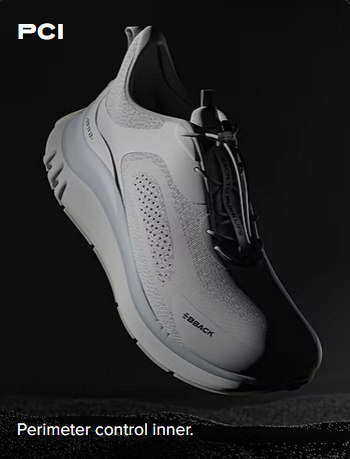
BBACK is a balance shoe that improves movement and makes each step easier.
PRO-DYNAMIC® tech supports natural motion, reduces pressure, and aids circulation.
Use code: POI10 for 10% off your order








Approved Medical Solutions
Your source for Oxalate free Nitric Oxide Supplementation
Non-licensed patients can use code “sbarrett” for a 10% discount.
Licensed practitioners can access the discounts by registering and when at checkout put “podofinquiry” (no space and not case sensitive) in the coupon section.

Ketone
Nitric Oxide
ClearDetox Pro & ClearSleep